Breaking the Chain

I have been working on some new habits recently.

Nothing crazy, but one of them is waking up 30 minutes earlier than usual.

Doing this helps me get a better jump on the day. Being up early provides some stillness to work on things before the day takes over and I am too tired in the evenings.

I can say confidently that I have been doing a pretty good job. About a month and a half into waking up early, I have done so almost every day, including weekends when I usually let myself slide a bit to recover from the week.

I printed out a little habits calendar and have been checking off days each time I get up at 6:15am. In just one month, it has gotten to a point where I wake up and think “don’t break the chain.”

Knowing my progress could be stopped by a simple 15 minute snooze under the blankets has propelled me out of bed to start my day.

This is why apps like Headspace, Duolingo and certain fitness apps are so effective. They track your progress and remind you not to break the streak. Who wants to break a good roll they are on?

This week has been a bit of a long week. Despite staying up a bit too late early in the week, I was still up at 6:15am. Yesterday, I went to the gym and worked out for an hour and a half after a long day of work. When I was getting ready for bed last night, I knew I was fried.

So, I did something I have been desperately avoiding for a month. I changed my alarm to 7:30am. I broke the chain before even going to sleep.

You might be thinking, so what? Big deal, Jeff.

But you know what? It is a big deal.

Ordinarily, when I break a streak like this it makes me feel poorly about myself, that I have let myself down. And my biggest fear is that missing one day will throw off all my progress.

However, after a full month of waking up early and enjoying the benefits of those extra 30-45 minutes in the morning. I am really not too worried about it.

Sometimes you need to recognize what the body and mind needs. Maybe it is an extra hour of sleep as it was in my case. Maybe it is skipping the gym to nurse a nagging injury. Maybe it is taking a night off of your passion project to let yourself recharge.

The point is, “don’t break the chain” is a great way to get you started. A great way to tap into your internal motivation to keep going. But it is equally important to know when it is okay to break the chain and have the confidence that you are going to start a new one the next day.

No self flagellation. No guilt. Instead, an opportunity to show yourself compassion and determination to get back at it after an off day.

Fear the Rut of Competence

I have recently found myself in a rut of competence. This is an idea popularized by David Epstein in the book “Range”.

Basically, I have found myself in a position where I was not really growing. Aging, yes. Gaining weight, also yes. Gaining gray hairs, okay you get the point.

At 34 years old, it was easy to fall into a routine, easy to think there wasn’t a lot of new going on. At this age, it is harder to make new friends, harder to start a new physical activity and even harder to learn a language than when we were younger.

I think it is important to note that I was not miserable for much of this rut, life was and is good. Good job, friends, some hobbies that get me moving like golf and softball. But nothing… new.

That was when I read “Range.” The main idea is that we hyperfocus on specializing, thinking that is the way we get ahead. We see it today with kids in sports, if you want that college scholarship you need to be playing baseball and baseball only from the time you are a fetus if you want a chance. But is that true?

The book opens with a comparison of Tiger Woods and Roger Federer. From the outside, 2 very similar men at the top of their game, but as you dive deeper, they couldn’t be further apart.

Tiger grew up with golf and only golf. His dad was a task master who had him hyper focused on his game from an incredibly young age. Was he successful? Hard to argue against all the records, tournament and major wins, but when you weigh that against his battle with personal demons, you have to ask, was that worth it?

Federer on the other hand played a variety of sports as a kid. His parents encouraged him to be diversified in the sports he played, leading him to focus on tennis far later than many of his contemporaries. Yet, Roger credits his diverse athletic background with much of his success in tennis where he is arguably the greatest of all time.

I used to think that my life and career path was a little meandering. I changed my major from journalism to economics during college. I worked as a restaurant manager with that economics degree before quitting, traveling the world, enrolling in an MBA program and becoming a management consultant.

The thing I have come to realize is that this meandering path is not so meandering and the skills I picked up working a busy dinner shift or making my way through Vietnam or working on a  presentation for grad school have set me up to be the person I am today.

Back to the rut of competence. I found myself a little stuck. Feeling like I was not in my groove despite lots of positive characteristics. What happened?

I got comfortable. I was seeking out activities and things that I was comfortable with. I was not pushing the envelope like I was at other times in my life. I was working from home. I was in a routine and not one that was fostering a growth mindset. 

So how do we get out of the rut of competence?

It might be different for everyone, but for me it was finding a new challenge. One of the things I did was sign up for F45 gym membership. This is a high intensity interval training class that changes the workout every day. No day is the same. I have always thought of myself as an athlete, but this class gets me going every day.

Finding a challenge. I went with Ryan Holiday’s Daily Stoic Habits challenge, this 66 day email course sent me a new challenge to do each day that helped me spread my wings and push myself out of my comfort zone and slowly I started to repel from the rut.

Now the problem with getting out of the rut of competence is that you find yourself in a new rut, a rut of incompetence! You are starting something new and of course you are going to suck at it. I felt like I was going to throw up my first week back at the gym. Had many days where I skipped or half assed the challenge for the day. It made me feel uncomfortable… and yet, I was growing.

Upon reflection, I realize that the most fulfilling times in my life were moments where I was challenged in this way but felt enough safety to make mistakes…

In my early days as a restaurant manager, I had no idea what I was doing. Fresh faced, 22 year old kid going up to tables to see how their food was. I was in over my head, but I had a team around me that supported me and kept me going.

Grad school was a challenge, lots of hard work, lots of learning new things and applying it fast. 

The point is, there is a shallower rut of competence in these more structured settings. It was easy enough to stick with the curriculum and move onto the next challenge.

But what do we do when we get older and those structures fade away?

No more curriculum. Busier schedules. Less time. More ego. The challenges that used to keep us going are no longer provided. It is up to us to seek them out and create the environment where we avoid the rut of competence or at least recognize it when it happens.

So, if you are like me and have found yourself in this rut, don’t despair, get out of your own head and take some action. As one my favorite podcasters Rich Roll says, “mood follows action.”

Go take some.

If you are struggling to find a direction, think about what you fear. In Ryan Holiday’s “Courage is Calling” he reminds us that our fears are a self-indicting guide that leads us to what we really need to do. Fear and resistance always votes for procrastination and hesitation. There is always a reason for not doing.

What are you making excuses for?

For me, it was writing and putting my creative voice out in the world. I have done it before, but every time I lose the momentum, it is a fight to get the courage to put it back out there.

I can’t be scared of what people think, well I can and still am, but I am reminded of the quote by Epictitus, “if you wish to improve, be content to appear clueless or stupid.”

When we run towards comfort, we are running away from an opportunity to grow.

But what about all the people who started before me… don’t they have a huge head start? I will never catch up.

Nonsense. The myth of the head start is overrated. Sure, the best day to plant a tree was 20 years ago, but the next best time is today.

There is copious evidence that head starts often fade out over time. The better approach is to have a growth mindset and adjust as you go along.

No one is good at things right away. But if you have the courage and discipline to continue the pursuit, plan and adjust as you go, the head start won’t mean nearly as much.

Don’t fear the rut of incompetence. It keeps you sharp and whether you know it or not, is broadening your horizons.

Fear the rut of competence and take action to stay out of it.

Change the Damn Water Filter

I admit, this is a silly problem.

The water filter on my refrigerator has been in need of changing for longer than I care to admit. Not just that the little light was on telling me it was time to change, that is easy enough to ignore. The water had slowed down to a glacial pace when filling up a glass of water.

Finally, the other morning, I had enough. After another session of filling up the water glass in the morning, I immediately pulled out my phone, opened my apartment’s residence app and put in a work request for a new water filter. (Yes, I live in an apartment and don’t even have to do this myself!)

Within 6 hours, the problem has been resolved and the water is flowing like Niagara Falls (I even overflowed a couple glasses because I was so used to it being slow).

After enjoying a few glasses of fresh water, I found myself wondering why I suffered for so long when the issue could be resolved in less than 2 minutes of my effort.

I procrastinate in many other arenas, ones that I can make much better excuses for, but putting in a work request? Come on man.

“The most pernicious aspect of procrastination is that it can become a habit. We don’t just put off our lives today, we put them off til our deathbed.” While perhaps a bit extreme in the case of changing a water filter, I did change the filter after all. This line from The Art of War by Steven Pressfield stood out to me because this incident made it clear that I was making procrastination a habit.

The water filter became just another thing that “I will get to tomorrow.” Another minor task looming over me. I wasn’t thinking about the water filter all the time, but I was reminded of it every time I was thirsty.

It was easier to continue to live with the default option than take action.

This is a widely documented phenomenon in the field of behavioral economics. Many studies have shown that when there is a default option – in other words, the option that will prevail if the chooser does nothing – most people will stick with that default even if it is not in their best interest. This has been proven when it comes to activities ranging from saving for retirement to choosing a healthcare plan. 

So what happened with my water filter? I chose to stick with the default. Other options, like addressing the problem, were very much available, but I was content with the status quo.

What are some things I can do to prevent this in the future?

Maybe set a reminder on my phone for a few months from now reminding me to put in the work request for a new filter before it starts going bad.

But even more broadly, these tasks and decisions that we punt on weigh on us. The best thing to do with a nagging problem like this is to just do it now. Or at a minimum do it early. I find that when I knock out activities like maintenance requests in the morning I feel some sense of accomplishment. Additionally, tasks like this at the end of the day tend to be draining to me. Get it done, get it over with before the day takes over.

I challenge you to think about the water filters that need changing in your life and just fucking do it.

And if you are still reading and think I am an idiot for writing this piece about my water filter, I will leave you with this quote from Nudge by Richard Thaler.

“People aren’t dumb. The world is hard.”

Here is to making the world a little easier.

Turning 30 and Thinking about the Journey

Today I turn 30.  When I wrote my birthday reflections these past 2 years, I wrote a list of things I learned. This year, I am going to reflect on one big lesson, the journey.

“Success is a journey, not a destination. The doing is often more important than the outcome.”

When I graduated high school, I chose this quote by tennis great Arthur Ashe to go under my picture in our yearbook. Looking back on it, it is a pretty profound quote and one I did not fully appreciate when I picked it at age 18.

I am sure I am not alone, but when I was 18 I had a romantic image of where I would be by 30. I imagined by 30 I would have “figured it all out.” Out of all the things I have learned in my first 30 years, one of the most important is how big a trap “figuring it all out” can be.

These past few years have really been a journey of self-exploration and discovery for me. I thought this past year, pursuing my MBA, was the culmination of that self-exploration. However, what I have learned is that this journey of self-discovery and awareness never ends. We never “figure it all out” and those that appear to or say that they do, probably don’t.

The important thing to figure out, is our purpose in this life. I am still working on this one, but I do believe I have a better sense of my purpose after investing in my personal growth and development. I believe it is important for all of us to think about and define our purpose and what motivates us to live up to that purpose.

In one of my classes this year, we learned about theories of motivation. Frederick Herzberg’s two-factor theory refutes the idea that job, and life, satisfaction is one vast spectrum with satisfaction on one side and dissatisfaction on the other.

According to Herzberg, there are aspects of our job, that if not done right, can cause us to be dissatisfied. He calls these elements hygiene factors. These are factors like job status, job security, pay and working conditions. If you have poor hygiene factors, you are likely dissatisfied with your work. Interestingly, having good hygiene factors does not mean you will be happy, it just means you won’t hate your work.

On the other hand, there are intrinsic parts of our jobs that act as motivating factors. These factors include work that challenges you, opportunities for recognition, a sense of responsibility and room for personal growth. It is these elements of a job that make us love to go to work instead of dreading another day.

I believe, and hope, that we have all had experiences where we have felt that kind of motivation.

I also believe that many of us, myself included, make choices only in the pursuit of hygiene factors. When I applied for graduate school, I wrote my application essays about my goals of being an entrepreneur and making an impact on the world. I still have that dream, but it is interesting how easy it is to fall back to a focus on those hygiene factors.

I can’t help but think about the pressure to prove that the investment of time and money to get this degree was worth it. I can’t help but feel the pressure to land a job with a good salary to help pay back the loans I took to go back to school. Even with the best of intentions, the pressure to settle for the hygiene factors is always there.

Herzberg’s theory is not just about work, it is about life in general. You don’t have to look far to see stories about celebrities or the ultra-wealthy who have all the hygiene factors covered but seem to live deeply unhappy lives.

Again, it is easy to focus on these external markers of success. These are the symbols that tell the world we made it. These are the things we can show off to our friends and family on Instagram or LinkedIn. Most likely, these kinds of symbols are serving our ego and not our purpose. As one of my favorite authors, Ryan Holiday writes, “Ego is the Enemy.” Motivating factors are much more personal and harder to articulate in a social media post, but they are the factors that lead to a happy and fulfilling journey.

To be clear, I am not saying that making money or having a high-status job means you will be unhappy. I am saying that if you let those kinds of factors be the priority, you may end up running on a treadmill that never stops. Herzberg’s theory suggests that if you prioritize motivators over hygiene factors you are much more likely to enjoy your job and your life.

I encourage all of us to ask if we are on a path that is meaningful for us. Ask if we have an opportunity to grow. Ask if we are learning new things. Ask if we are in a position to succeed and be recognized for it. These are the important questions, not just the external measurables that are so easy to focus on.

This year has truly been one of the most impactful in my life thus far. I have studied with colleagues from over 40 different countries who have become family to me, I spent time studying and traveling in Europe for 6 weeks and next week I graduate with my MBA. All of these moments, the good, the tough and the in between, have made me a better person. At the end of the day, life is made up of moments and it is important to appreciate them as we tackle our goals. I am grateful for all of it.

As I embark on this next decade of my life, I recognize my journey of discovery and learning never ends. However, it is time to put some of this learning to work and I am excited for this next chapter in my life. Thank you to all who have been a part of my journey so far.

Anyway, happy birthday to me. Happy regular July 31st to you. I hope we can do this again next year.

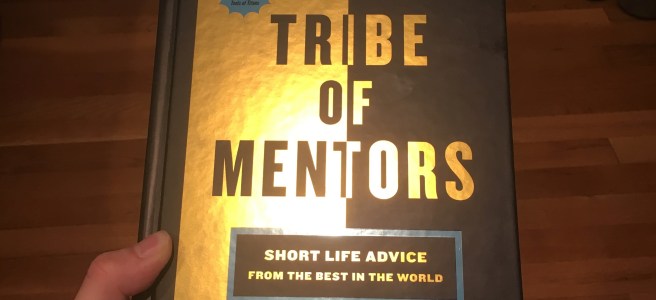
“Tribe of Mentors” Review

First time trying this book review business out.

I have become a rather big fan of Tim Ferriss, his books and podcast. Naturally, his new book “Tribe of Mentors” was right at the top of my holiday list and is my first book 2018.

In the intro, Tim writes about finding himself in a bit of a life crisis turning 40. The questions he was asking himself certainly hit home for me as I have been experiencing a quarter-life crisis of my own this past year. He talks about questioning his goals and motivations, how he can be kinder to himself, and what he may have missed out on due to underplanning or overplanning. Thinking about his goals and desires, he decides to email out a list of 11 questions to his “tribe of mentors.” When I first read that the whole book was a variety of people answering the same questions, I was a little turned off. I am glad I got over that brief hesitation, because the rest of the pages were filled with so many ideas, tactics, books, quotes, and mental exercises that I made a note or highlight on most of them.

Ferriss describes the book as a “create your own adventure” book. Many of the profiles and answers were impressive, some did not resonate, but at least 20% really hit home for me. At the onset, I thought I would skip some of the profiles if the person did not pique my interest. After reading the first 10 or so profiles, I realized I was definitely going to be reading every page. I thought I wouldn’t be interested in some of them, but a couple mentors really surprised me and I was hooked.

While there are so many highlights, I want to sum up my main takeaways.

1) “Life is 25% finding yourself and 75% creating yourself” – Time and time again, the reader is reminded that you have the power to control the story of your life. So many of the limits put on us by others and by ourselves are made up. So many of the mentors in this book made drastic changes in their lives, professionally and personally. It is a nice reminder that we are the authors of our lives. At the same time, we can’t sit idly by and wait for life to happen to us, we have to make life happen. This can be a tad intimidating, but leads right into the next lesson…

2) “Focus on the next 5 minutes.” –  Over the last year, I have made a lot of changes in my life and I have put a lot of pressure on myself to “figure everything out.” The idea of “figuring everything out” is wildly overwhelming and often leads to frustration and inertia. Tim encourages all of us to plan, but focus on what is right in front of us. We can’t think our way out of a situation. The only way out is to take one step at a time. We can’t change the past, however, we can control how we approach any situation in the next 5 minutes, we can choose to be happy in the next 5 minutes. When we have this perspective, it is comforting that we can recover from any misstep. I am already reflecting on times that I didn’t “get what I want” that led to a far better opportunity down the road. Comedian Patton Oswalt wrote, “my favorite failure is every time I ever ate it onstage as a comedian. Because I woke up the next day and the world hadn’t ended.” Amen.

3) “Life punishes the vague wish and rewards the specific ask.” – Oh man, this one punched me in the face. Tim writes this in the introduction, but I am reminded of it constantly throughout the book. Often, “What should I do with my life?” is an awful question (and one I have said to myself, and others, many times… admit it, we all have). It is way too broad and gets you out of that “focus on the next 5 minutes” mindset. It is massively overwhelming to consider how you are going to lay the building blocks that make up your lifetime. In addition, we all know those blocks are going to move, disappear, slide, and more blocks will show up when you least need more blocks. This may appear at odds with creating the life you want to lead and not letting life happen to you. However, if you do you best to focus on making the next 5 minutes the best you can, and you are actively taking steps to create the life you want to live right now, then you will be better prepared to go with the flow when the building blocks of life don’t line up exactly according to plan (which they certainly will).

I am confident someone else will have a different take than me, and I think that is the beauty of a book like this (and any book in general for that matter). After reading 140 different takes on the same high level questions, I am reminded that there is no “right way” to go through life. Success means different things to different folks. While this is a liberating notion, I feel like it lights a little fire under my butt to do the things I want to accomplish, be the person I want to be, and live the life I want to live. We all have the power to write the next chapter of our lives even if it seems out of context with the rest of the story so far.

Dream big and start small.

Final Take: 4/5 Stars. If you have not dabbled in the Tim Ferriss collection, I would recommend starting with last years book, “Tools of Titans.”